

A Homage to the man of convictions
If looks could kill, Shashi Kapoor would have been booked for ‘knocking out’ millions with his lethal charm. Alongside Dharmendra, he was the finest-looking Indian actor, and while both the large-hearted Punjabi gentlemen could make cinegoers swoon by just their adorable smiles, it was Shashi who had a greater ability to carry the garb of a villager and a suave urbanite with finesse. Just as the golden sunshine of throat qualified Rafi Sahab as God’s own voice, Shashi’s endearing persona made him seem as nature’s symbol of eternal youth, and it is not surprising that his gorgeous charm made him a darling of national and international cinema.
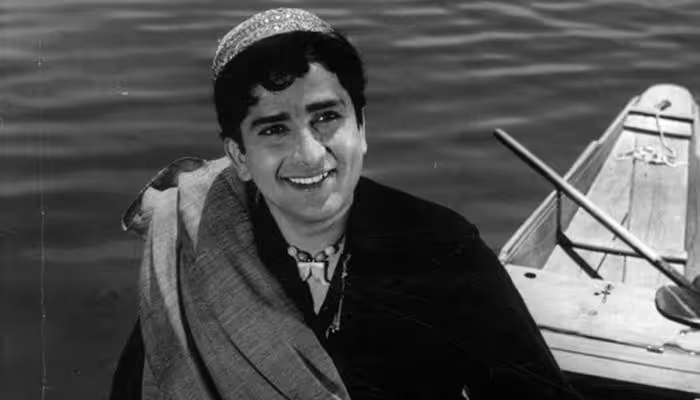
Since cinema is a gigantic spectacle that overwhelms audiences with glitz and glamour, many of the personal traumas, tragedies and sacrifices of artists are never realised by the public. Like the “sweetest songs are those that tell of saddest thought”, Shashi Kapoor’s life was bogged by “celestial interactions” that made him “suffer” as an artist and person in equal measure. For an actor who romanced his way to “marital success” in almost every screen story, it is heart-rending that Shashi’s own love marriage was torn apart by the demise of his beloved Jennifer Kendall in the prime of his career. Forty-six was no age to lose a life partner like Jennifer especially as she was the fulcrum of Shashi’s existence and perhaps that led to the decline of health and career of a man who was akin to Adonis of Greek mythology.
An actor by legacy as well as training, Shashi was a spontaneous artist whose best performances came when his roles were well etched out. A director’s delight, he could astound even in the minutest of roles, whether as a suffering child protagonist in “Awaara” or the driver in “Waqt” or the middle-aged man in “Doosra Aadmi”. Of course, his stunning persona and winsome smile made him tailor-made for romantic films, yet it is strange that not many movie makers cast him in serious roles despite his intense performances in films like “Dharamputra”, “Kalyug” and “New Delhi Times”. But if people applauded his versatility in “Aamne Saamne”, “Jab Jab Phool Khile”, “Householder”, “Bombay Talkies”, “Vijeta”, “Junoon”, “Kabhi-Kabhie” or “Deewar”, they were equally mystified and offended by his presence in mediocre films like “Shaan”, “Faqira”, “Saalakhein” and umpteen others where he just went through the motions. It seems the trappings of the commercial cinema came in the way of experimentation, and a fine actor like Shashi was typecast, though he could have done justice to a variety of roles.
Defending him for accepting many such pedestrian films, the late Sagar Sarhadi, in a private conversation with me several years ago, stated that “Shashi was too compassionate and caring to refuse producers who came to his door”. And since “he couldn’t be rude or discourteous, Shashi burdened himself with films that were neither good for his image nor for his health”, earning him the sobriquet of “Taxi” from his own elder brother Raj Kapoor. Terming Shashi as a gifted actor who gave shape to many a role, the late scriptwriter cited how Shashi had provided dignity and depth to the character of Vijay Khanna in “Kabhi-Kabhi”. Though Sarhadi wrote the film, he said the “actor of merit” gave wings to his script by the manner in which he chided protagonist Amitabh or interacted with his son (Rishi Kapoor on screen), revealing why he was one of the most loved romantic heroes of India! Sagar even credited Shashi’s deft underplay in “Deewaar” as the reason for providing a halo to Amitabh’s “vocal and volatile character”. My own assessment is that despite his immense potential for comedy, as exhibited in “Pyar Kiye Ja”, “Aamne Saamne”, or “Chor Machaye Shor”, the film directors were guilty of not entrusting Shashi with an out-and-out comic project as he would have stamped his class in that genre.
However, it must be understood that the illustrious Dadasaheb Phalke Award was not awarded to Shashi Kapoor, the actor, but to a visionary who had the courage of convictions to deliver meaningful cinema and theatre in this country. Unlike his many peers, he didn’t amass wealth from real estate or other businesses but had guts to invest lifelong earnings into producing off beat films like “39 Chowranghee Lane”, “Junoon” and several others. In a private chat with this writer some years ago, Shabana Azmi described Shashi as “a trailblazer who was not just the first actor to act in Hollywood but also the first mainstream actor to produce art cinema”.

Shabana also praised Shashi and his beloved wife, Jennifer, for keeping the theatre movement alive and kicking in the concrete jungles of Mumbai. Even though Prithvi Theatre in the metropolis was worth millions, the sensitive Piscean has to be saluted for dedicating the prime property “to provide a cultural space like no other” to actors, writers and directors to showcase their talent.
By conventional evaluation, Shashi may have erred, but it is a flaw that made him acquire a towering stature as a saviour of good cinema and theatre. In terms of returns on investment, producing unconventional films as well as keeping Prithvi theatre alive was and has been a losing proposition. Many even questioned his wisdom but like all true seers and visionaries, Shashi rose above filial relations and rather than save for family, adopted the entire fraternity of artists as his own to become an exemplary patron of art and cinema. True, it is also a tribute to the memory of his dear father and the spirit of his wife but it does show that good, honest people do what is necessary rather than what is convenient.
The strange paradox is that despite never going to college, Shashi had an above-average understanding of Shakespearean drama, although he never appeared in a theatre production after becoming a film actor. Although he inherited the legacy and love of theatre from his prodigal father, Prithviraj Kapoor, who called “theatre as the greatest temple on earth”, Shashi’s true understanding of theatre grew only after his bonding with Jennifer Kendall (her father Geoffrey Kendall ran a travelling theatre company in India) and witnessing the grass root struggles of stage productions made him a lifelong devotee to the cause of theatre. That is why it is sad that Shashi was criticised for enacting in some atrocious films, without understanding that he did so only to keep theatre and meaningful cinema alive in India. But in the process, he not only damaged his image but also his health and wealth.
Unfortunately, by the time people understood Shashi’s actions were for a “noble cause”, the handsome actor was in no position to garner the compliments since he had lost touch with reality. You can say the petals had withered long before the flower was plucked but it is indisputable that the fragrance of Shashi Kapoor’s visionary deeds will keep emanating from “Prithvi” to the distant horizons for a long, long time.
Well written and articulated
Shashi Kapoor was one of my favourite actors and as a child I had curly hair (even now I have curly hair) but at that time they resembled his hair style.
Your Bollywood pitara has so many untold stories and enigma of bygone stars which is an interesting read